
Institutional history
History of Edavaka Grama Panchayat
Establishment and Geography
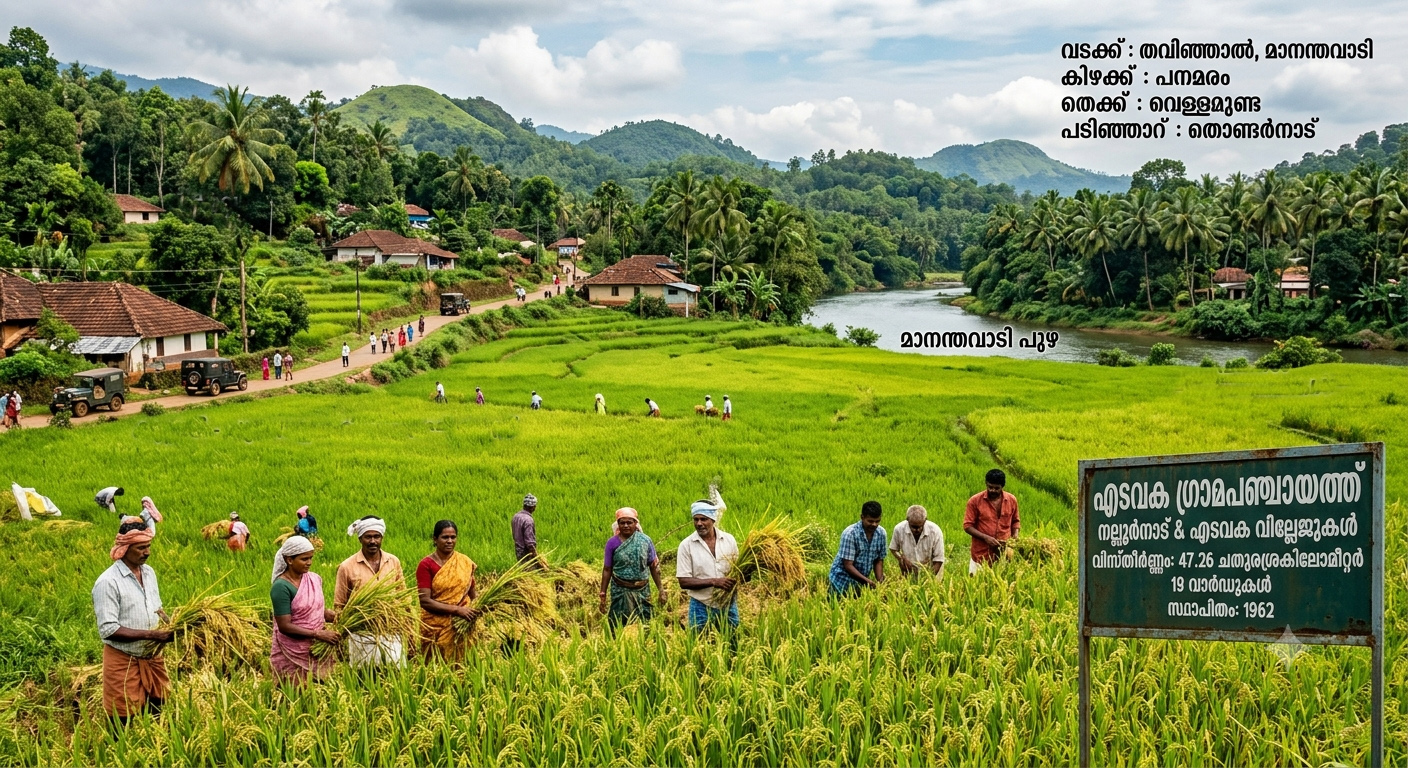
Edavaka Grama Panchayat is situated in the Mananthavady Block of Mananthavady Taluk in Wayanad District. Spread across the villages of Nallurnad and Edavaka, the Panchayat covers an area of 47.26 square kilometers and consists of 19 wards.
The Panchayat is bordered by the Mananthavady River and the Panchayats of Thavinjal and Mananthavady to the north, Panamaram Panchayat to the east, Vellamunda Panchayat to the south, and Thondernad Panchayat to the west.
Edavaka Panchayat was officially formed in 1962. From 1962 to January 1964, the administration was under a Special Officer. The first elected governing body came into existence in 1964, with P. Kunjiraman Nair serving as the first President.
The remarkable development seen in the Panchayat today is largely attributed to the hard work and determination of migrant settlers. The famous “Edavaka paddy seed,” cultivated by local farmers, became renowned throughout Kerala for its high productivity and resistance.
The historic Kutyadi–Pakranthalam–Mananthavady route is mentioned in Logan’s Malabar Manual. Early settlers reached Wayanad through this route and established permanent settlements in the region.
Around the year 1500, the Azhvanchery Nambiars from Chovva near Kannur migrated to Wayanad and settled in Edavaka. They named their settlement “Chovva” after their native place. Traders from Nadapuram and Kuttiady frequently visited the area to purchase paddy and cattle, exchanging commodities such as coconut oil, coconuts, and tobacco. Most of these traders were Muslims, though people from other communities also participated in trade activities.
Several prominent individuals from this region actively participated in the Indian National Movement.
Social and Cultural History
Like many parts of India, Wayanad once had a strong Jain presence. Evidence of this can still be seen in places like Sultan Bathery, Kalpetta, and Kaniyambetta, where Jain temples and families existed.
Historical evidence suggests that Jains also lived near present-day Pandikkadavu in Edavaka Panchayat. This area, once famous as “Tharakanangadi,” now has only a few Jain families remaining. The term “Tharakan” referred to revenue officials of the time and later became hereditary.
A renovated Jain temple still exists in the region. During the Jain period, the area was also known for renowned Ayurvedic physicians. Because medicinal herbs and medicines were easily available in the local markets, the place became known as “Tharakanangadi.”
Similarly, Pallikkal Angadi developed around centers of learning and spiritual instruction. The word “Palli” in the Pali language refers to places where spiritual teachings, education, royal proclamations, and public announcements were conducted.
The temple at Palliyarakkal near Pandikkadavu also has a similar historical background.
Before the invasion of Wayanad by the Kottayam rulers, Kannada was the dominant spoken language in the region. Among the rulers of Wayanad, the most powerful was the Beda King known as “Battath Dwarai.” The Kottayam rulers later defeated and killed him.
Many Jains who refused to surrender migrated to Karnataka, while others fled into forests. Some later returned and worked as laborers in rural areas; they are believed to be the ancestors of the Paniya community. The Kannada influence in the Paniya language supports this belief.
Those who remained permanently in the forests later became communities such as the Kurumars and Adiyars.
According to local tradition, during the Kottayam invasion, a Jain named Brahmasuri surrendered a ceremonial sword kept in the Palliyara Temple to the king and sought protection. The king ordered the family to preserve and worship the sword in their home. Even today, a Jain family at Pandikkadavu preserves this sword, which is ceremonially carried every year to Valliyoorkavu.
Arrival of Islam and Muslim Settlements
The first Muslim to settle in Pallikkal was Sheikh Shahul Murtala, who had arrived to treat a girl from a Hindu family. After successfully curing her illness, the girl’s father gifted land to the Sheikh. The mosque built there later became known as “Kallyanath Palli,” named after the girl Kallyani.
Construction of the present mosque began in 1626. Interestingly, the mosque was built in traditional temple architectural style, probably because Persian and Arabian architectural influences had not yet reached the region.
Muslim families presently living in Pallikkal are believed to have migrated mainly from Nadapuram and Kuttiady.
During this period, the rulers appointed military leaders and local chieftains as landlords and protectors of land, leading to the establishment of the Janmi–tenant system in Wayanad.
Kurichya Warriors and Pazhassi Struggle
The Kurichya community arrived in Wayanad as warriors of the Kottayam kings. During the resistance led by Kerala Varma Pazhassi Raja against the British, the Kurichyas played a major role using guerrilla warfare tactics.
One of Pazhassi Raja’s prominent commanders was Edachana Kunkan, whose residence was near Kallody in Edachana Desam. After Pazhassi Raja was killed, the British captured and executed Kunkan and confiscated his property.
The famous “Thonnichal Thira,” celebrated by the Kurichya community with ancient rituals, is essentially a form of nature worship.
Remains of the palace built by Pazhassi Raja at Pandikkadavu can still be seen today.
National Movement and Migration
Several people from the region actively participated in India’s freedom struggle. Among them, Chaliyadan Ahamed was a prominent nationalist leader.
The “National L.P. School” started at Aylamoola itself reflects the patriotic spirit of the period.
Large-scale migration from Central Travancore began around 1940. Migrants mainly came from places such as Pala, Muvattupuzha, and Koothattukulam due to food shortages caused by the Second World War.
Settlers travelled by bus from Kozhikode and Thalassery using the existing Mananthavady–Kozhikode road. They faced severe cold, heavy rains, floods, forests, malaria, leeches, and wild animals while establishing settlements.
The first migrant settler to arrive in Kallody was Vettiyankal Mathai. He encouraged other settlers arriving in Mananthavady to move into Edavaka and Edachana regions.
At that time, farmers occupied revenue land in Edachana without formal payment. The tireless efforts of migrant farmers transformed the Panchayat into a prosperous agricultural region.
Priests such as Fr. Thomas Kalam, Fr. Lukose Poondikkalam, and Fr. Joseph Memana played major leadership roles during this developmental phase.
Many roads in Edavaka were made usable through voluntary labor campaigns. The Mananthavady–Kandathuvayal road passing through Edavaka was reportedly built in a single day through the collective effort of ten thousand people.
Agriculture and Development
Initially, tapioca, paddy, and millet were the main crops cultivated in the region.
The famous “Edavaka paddy seed” became widely respected across Kerala for its high yield and disease resistance. Agricultural scientists also recognized its exceptional productivity.
Most paddy fields in the region were originally ponds, marshlands, or wetlands that were later reclaimed and cultivated.
Education and Healthcare
In earlier times, only two lower primary schools existed in Pallikkal and Paingattiri. Despite limited educational facilities, Wayanad’s first medical doctor came from this Panchayat.
Dr. P. Narayanan Nair from Ellumandam was the first MBBS and DCH qualified doctor from Wayanad.
Festivals and Religious Traditions
Major festivals and religious events in the region include:
- Feast of the Holy Virgin Mary at Kallody Church
- Thonnichal Thira
- Chovva Temple Festival
- Ambalavayal Thira
- Sheikh Shahul Makham Uroos
- Karimpilchal Thira
Origin of Place Names
The name “Edavaka” is believed to have originated from the nature of the soil found in the area. The soil was considered neither highly fertile nor infertile, neither upper-grade nor lower-grade land — thus becoming known as “Edavaka.”
“Nallurnad” means “Land of Good People.”
“Thonnichal” was named after its boat-shaped geographical formation.
Near Kallody lies a hill called “Chorankunnu,” notorious in ancient times for robber attacks on travelers. As travelers approached the region, they would tighten their clothes, carry stones for protection, and run in fear through the dangerous stretch. The place where people “ran carrying stones” eventually became known as “Kallody.”
“Pulikkad” was once a forest frequented by tigers.
Nearby lies “Banglaw Kunnu,” where British officials are said to have built stone houses. Those stone structures later gave rise to the name “Kammana.”